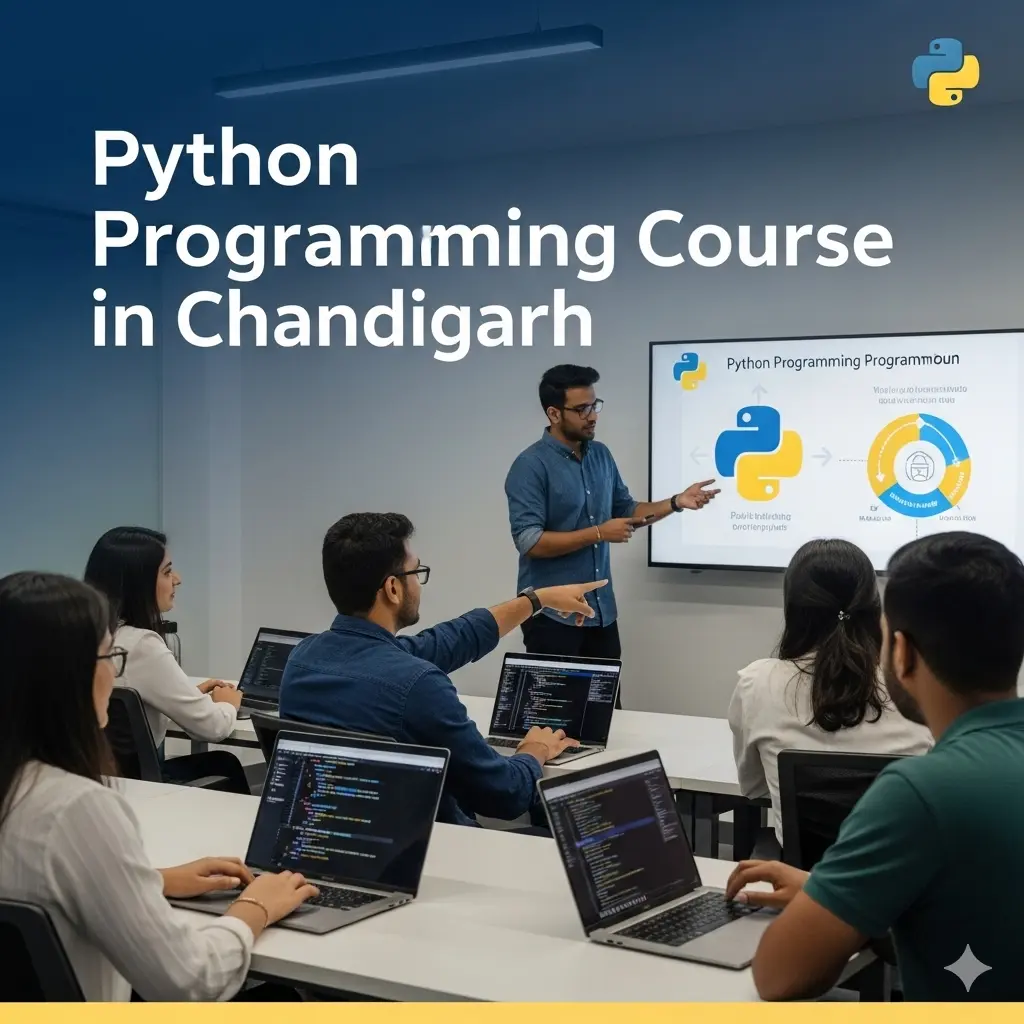
Python has become one of the most widely used programming languages for software development, web development, automation, data analysis, artificial intelligence, and machine learning. Its simple syntax and powerful libraries make it suitable for beginners as well as experienced developers. For students and IT professionals looking to build a career in programming, Python Training in Chandigarh can provide a structured path to learning programming concepts and developing practical applications.
Python is not limited to basic programming. After learning the fundamentals, students can explore advanced technologies such as Django, database development, APIs, automation, data science, and backend web development. With practical training and project-based learning, learners can understand how Python is used to create real-world applications.
What Is Python?
Python is a high-level, general-purpose programming language known for its readable syntax and extensive ecosystem of libraries and frameworks. It can be used for many different types of software and technology projects.
Python is commonly used in:
- Web development
- Software development
- Data analysis
- Artificial intelligence
- Machine learning
- Automation
- Scripting
- API development
- Testing
- Database applications
One of Python’s biggest advantages is that its syntax is relatively easy to understand. This makes it a popular starting point for people who are new to programming.
Why Learn Python?
Python offers a wide range of applications, making it a valuable programming skill. Beginners can start with basic programming concepts and gradually move toward specialized areas.
Some important benefits of learning Python include:
Easy-to-Understand Syntax
Python uses a clean and readable syntax. Beginners can focus on understanding programming logic without being overwhelmed by complex syntax.
Wide Range of Applications
Python can be used for web development, automation, data analysis, AI, machine learning, and many other areas.
Large Ecosystem
Python has a large collection of libraries and frameworks that help developers build applications more efficiently.
Useful Career Skill
Python knowledge can support career paths such as Python Developer, Backend Developer, Web Developer, Data Analyst, Automation Developer, and other technology roles.
What You Learn in Python Training
A structured Python program generally begins with programming fundamentals before progressing toward advanced development.
Python Fundamentals
Students can begin by understanding:
- Variables and data types
- Operators
- Conditional statements
- Loops
- Functions
- Lists
- Tuples
- Sets
- Dictionaries
- Strings
- Input and output
- Exception handling
These concepts provide the foundation required for writing Python programs.
Object-Oriented Programming
Object-Oriented Programming, or OOP, is an important concept for developing larger applications.
Students can learn:
- Classes and objects
- Constructors
- Inheritance
- Encapsulation
- Polymorphism
- Abstraction
- Methods and attributes
Understanding OOP helps learners write organized and reusable code.
Learn Django for Web Development
Django is a popular Python web framework designed for developing web applications. It provides developers with tools and features that simplify many common web development tasks.
Learning Django can help students understand how to build complete backend applications using Python.
A Django-focused curriculum may include:
- Django installation
- Project and application structure
- URL routing
- Views
- Templates
- Models
- Forms
- Django Admin
- Authentication
- Database integration
- CRUD operations
- REST APIs
- Application deployment
Django follows a structured development approach, which can help developers manage complex web applications.
Python and Database Development
Most web applications require a database to store information. Python applications can work with different database systems depending on project requirements.
During practical training, students can learn database concepts such as:
- Creating databases
- Creating tables
- Inserting records
- Updating data
- Deleting records
- Retrieving information
- SQL queries
- Database relationships
- CRUD operations
Python can be connected with databases such as MySQL, PostgreSQL, and SQLite.
Database knowledge is particularly important when developing applications such as e-commerce platforms, customer management systems, student portals, booking systems, and business applications.
Build Real-World Python Projects
Project-based learning is an important part of programming education. Instead of only studying theoretical concepts, learners can apply their knowledge by developing practical applications.
Possible Python and Django projects include:
- Blog management systems
- E-commerce websites
- Student management systems
- Employee management applications
- Online booking platforms
- Job portals
- Inventory management systems
- Customer management systems
- News portals
- Business websites
- REST API applications
Working on projects helps students understand how programming concepts are combined to solve real-world problems.
Python Web Development
Python can be used as a backend technology for modern web applications. Developers can use Python frameworks such as Django and Flask to create server-side applications.
A typical Python web application may include a frontend interface, backend logic, database, authentication system, and APIs.
Students can learn how these components communicate with one another and how information moves between the user interface and server.
Understanding backend development can help learners create dynamic websites instead of only static web pages.
Learn REST APIs with Python
APIs are an important part of modern software development. They allow different applications and services to communicate with each other.
Python and Django-based technologies can be used to develop REST APIs for websites, mobile applications, and other software systems.
Students can learn concepts such as:
- HTTP methods
- GET and POST requests
- JSON
- API endpoints
- Authentication
- Request and response handling
- Data validation
API development can be useful for building applications that communicate with mobile apps, frontend frameworks, payment services, and third-party platforms.
Python for Automation
Python is also widely used for automation. Developers can create scripts that perform repetitive tasks automatically.
For example, Python can be used for:
- File management
- Data processing
- Report generation
- Web automation
- Data extraction
- System tasks
- Automated testing
Learning automation can help students understand how programming can be used to improve productivity and reduce repetitive manual work.
Python Training for Beginners
Python is suitable for beginners because learners can start with simple programs and gradually progress toward advanced concepts.
A beginner can start by learning variables, loops, conditions, and functions. After developing programming fundamentals, they can move into OOP, databases, Django, APIs, and project development.
Consistent practice is important. Writing small programs regularly can help learners improve their logical thinking and problem-solving abilities.
Who Can Join Python Training in Chandigarh?
Python training can be useful for a variety of learners.
Students
Students pursuing computer science, IT, engineering, or related fields can use Python training to develop practical programming skills.
Freshers
Fresh graduates can build Python projects and portfolios to demonstrate their programming abilities to potential employers.
Working Professionals
Professionals who want to expand their programming knowledge can learn Python for web development, automation, data-related work, or backend development.
Beginners
People with limited programming experience can begin with Python fundamentals and gradually move toward advanced development.
Freelancers
Freelancers can use Python and Django to develop websites, backend systems, APIs, and customized web applications for clients.
Career Opportunities After Python Training
Learning Python can open the door to several technology career paths. Depending on their additional skills and specialization, learners can explore roles such as:
- Python Developer
- Django Developer
- Backend Developer
- Web Developer
- Software Developer
- Full Stack Developer
- Automation Developer
- API Developer
- Data Analyst
- Machine Learning Developer
Career requirements vary between organizations, so learners should continue developing programming, database, communication, and problem-solving skills.
How to Choose Python Training in Chandigarh
Before joining a Python course, students should check the curriculum and practical learning opportunities.
Important factors to consider include:
- Python fundamentals
- Advanced Python concepts
- Object-oriented programming
- Database integration
- Django framework
- API development
- Practical assignments
- Real-world projects
- Version control
- Deployment concepts
- Experienced instructors
A course that combines classroom learning with regular coding practice can help learners develop stronger programming habits.
Importance of Practical Learning
Programming cannot be mastered through theory alone. Learners need regular practice to understand how code works and how programming problems can be solved.
Practical projects provide an opportunity to work with databases, application logic, user authentication, APIs, forms, and other components of real applications.
For example, developing an e-commerce application can teach learners how to manage products, users, shopping carts, orders, and databases. Such projects can also become part of a student’s development portfolio.
Conclusion
Python is a versatile programming language with applications across web development, automation, data analysis, artificial intelligence, and software development. Learning Python fundamentals and then progressing toward Django and database development can provide a strong foundation for building modern web applications.
Python Training in Chandigarh can help students, beginners, freshers, and professionals develop programming skills through structured learning and practical projects. By learning Python, Django, databases, APIs, and web development concepts, learners can work toward creating real-world applications and developing a professional programming portfolio.
The most effective way to learn Python is to combine concepts with regular coding practice. Start with the fundamentals, build small applications, progress toward Django and database integration, and gradually take on larger projects. With consistent learning and hands-on development, Python can become a valuable skill for a career in modern web and software development.